Saving money every month sounds straightforward — until you actually try to do it consistently over six months or a year. Life has a way of filling available income with expenses that feel essential but quietly prevent savings from building.
Learning how to save money every month is far less about earning more and far more about building the right habits around what you already earn.
The good news is that small consistent changes compound significantly over time. Cutting £50 or $50 per month in unnecessary spending is £600 or $600 per year — money that could fund an emergency buffer or accelerate a longer-term goal.
The habits that produce those savings in how to save money every month do not require dramatic lifestyle sacrifices. They require awareness and a few simple systems.
Running a business like Vestes taught me that cash flow awareness, eliminating waste, and building buffers are habits that work whether you manage a business account or a personal one.
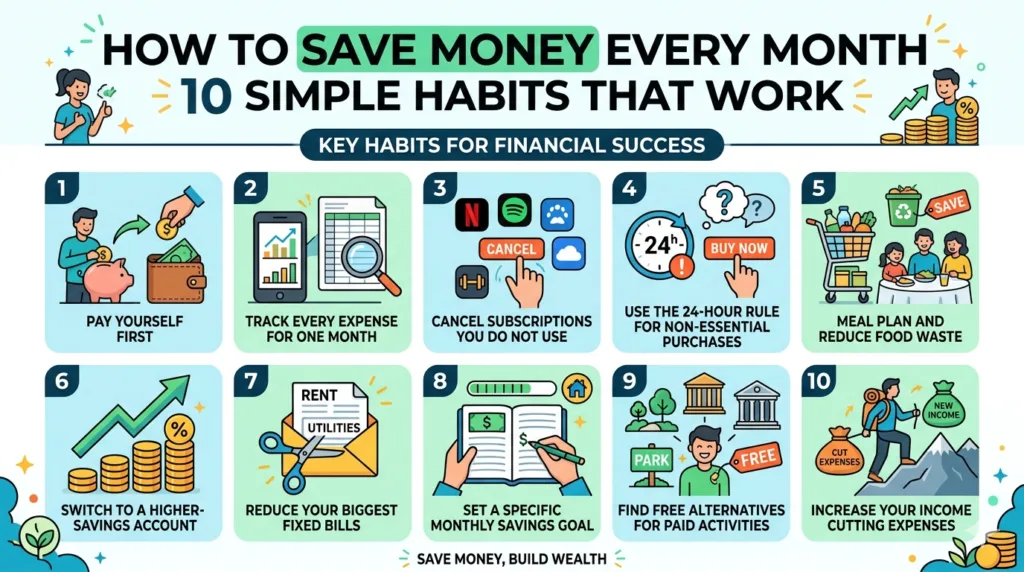
This guide covers ten of those habits applied directly to how to save money every month on any income level.
💡 Why Most People Struggle to Save Every Month
Before the ten habits, it helps to understand why how to save money every month is consistently harder in practice than it sounds in theory.
The core problem with how to save money every month for most people is treating saving as what happens with whatever is left at the end of the month. If there is £100 remaining, they save £100. If nothing is left, nothing is saved. This reactive approach means savings are always competing against expenses — and expenses almost always win.
The solution is to flip the order. Pay yourself first — move a fixed amount into savings the moment your income arrives, before any spending decisions are made. This single structural change is the foundation of how to save money every month reliably rather than occasionally.
💰 Habit 1 — Pay Yourself First
The single most powerful habit for consistent monthly savings is also the simplest — automate a transfer to savings on the same day your income arrives. Not at the end of the month. Not when you remember. The same day.

Set up an automatic transfer on the day your income arrives — even if it is just £20 or $20 to start. You cannot spend what is not in your current account.
This simple automation removes the willpower requirement from saving entirely and makes consistent monthly saving the default rather than the exception in how to save money every month.
Start with whatever amount feels manageable — even a small consistent saving builds the habit and can be increased as your income grows or expenses fall. The amount matters far less than the consistency and the automation in the early stages of learning how to save money every month. Getting the system in place is the achievement.
📊 Habit 2 — Track Every Expense for One Month
Most people who struggle with monthly savings have only a vague idea of where their money actually goes. Subscriptions they forgot about. Takeaway spending that adds up to twice what they estimated. Small daily purchases that seem negligible individually but add up to hundreds per month.
Spending one month tracking every single expense — every coffee, every subscription, every impulse purchase — is one of the most eye-opening exercises for savings improvement. Most people are genuinely surprised by what they find.
Free tools like a simple spreadsheet, the Notes app on your phone, or budgeting apps like Emma or Money Dashboard make this straightforward.
You do not need to change anything in that first month. Just track. The act of seeing your spending clearly almost always reduces waste because awareness changes behaviour without requiring willpower.
By the end of the month you will have a precise picture of where the real opportunities to how to save money every month exist in your own budget — and that clarity is worth more than any single spending cut.
📱 Habit 3 — Cancel Subscriptions You Do Not Use
Subscription creep is one of the most common hidden barriers to consistent monthly savings. Most people have between five and fifteen active subscriptions — streaming services, apps, gym memberships, software tools, meal kits — and regularly forget about several of them.
Go through your bank statements right now and list every recurring payment. For each one, ask yourself honestly: have I used this in the last 30 days? If the answer is no, cancel it today. If the answer is occasionally, decide whether the cost-per-use justifies keeping it.
The average person cancelling unused subscriptions when learning how to save money every month frees up £30 to £80 per month without changing a single spending habit they actually enjoy. That is £360 to £960 per year from a one-hour audit — one of the highest-return actions on this entire list.
🛒 Habit 4 — Use the 24-Hour Rule for Non-Essential Purchases
Impulse purchases are one of the most consistent obstacles to how to save money every month for beginners. The instant gratification of buying something new — clothes, gadgets, home items, takeaway food — provides a temporary emotional reward that bypasses rational spending decisions.
The 24-hour rule is the simplest intervention in how to save money every month for impulse spenders: for any non-essential purchase over £20 or $20, wait 24 hours before buying. In most cases, the urgency fades and you realise you did not actually need or want the item as much as you thought in the moment.
For larger purchases over £100 or $100, extend the waiting period to one week. This is not about never buying things you enjoy — it is about ensuring that the purchases you make are genuinely chosen rather than impulsively grabbed. Deliberate spending is one of the most practical habits for how to save money every month without feeling deprived.
🍳 Habit 5 — Meal Plan and Reduce Food Waste
Food is one of the largest and most variable expenses in most people’s monthly budgets — and therefore one of the highest-impact areas for how to save money every month. The combination of frequent takeaways, supermarket over-buying, and food waste drains significantly more from monthly budgets than most people realise.
Spending 15 minutes planning meals before grocery shopping consistently reduces food spending by 20 to 35 percent — one of the highest-return habits on this list.
You buy exactly what you need, waste less, and are less likely to resort to expensive last-minute takeaways when the week’s meals are already planned.
Cooking in batches — making large portions of lunches or dinners and portioning them for multiple days — extends the savings further. The upfront investment of 15 minutes of planning returns hours of time and significant money over the course of a month.
🏦 Habit 6 — Switch to a Higher-Interest Savings Account
Once you are consistently saving each month, where you keep those savings matters. Money sitting in a standard current account earns essentially zero interest. Moving it to a dedicated savings account — particularly a high-interest or ISA account — makes your money work harder without any additional effort.
This is one of the more passive habits in how to save money every month — it does not reduce spending but increases the return on every pound or dollar already saved.
According to MoneySavingExpert’s savings account comparison, the difference between the best and worst savings rates can amount to several hundred pounds per year on a modest balance — money earned simply by having savings in the right account.
⚡ Habit 7 — Reduce Your Biggest Fixed Bills
Most people learning how to save money every month accept fixed bills as unchangeable. They are not. Energy providers, phone contracts, broadband, insurance, and streaming bundles are all negotiable or switchable — and the savings from switching or renegotiating are often the largest single-line improvements available in how to save money every month.
Set a calendar reminder to review every fixed bill at renewal — that single habit is the key action for how to save money every month through bills without any ongoing effort. Use comparison sites to check for better deals.
Call your current provider before switching and ask for a retention offer — providers frequently give better terms to customers who are clearly about to leave.
Switching energy providers, phone contracts, and insurance at renewal rather than rolling over automatically saves most households £200 to £600 per year — all without changing any spending behaviour, just by being proactive at renewal time.
🎯 Habit 8 — Set a Specific Monthly Savings Goal
Vague intentions in how to save money every month rarely produce consistent results — a specific measurable target changes the psychology entirely. A specific, measurable target changes the psychology entirely. Instead of “I want to save more,” the goal becomes “I will save £150 by the end of this month.”
Specific goals trigger specific actions. When you know you need to save £150 and you currently have £80 in your savings pot on the 20th of the month, you identify specific things to cut in the remaining 10 days to reach the target. Vague goals allow comfortable inaction. Specific goals create the productive discomfort that generates results.
Building a specific monthly savings target into your how to save money every month routine — even reviewing it briefly on the 1st and 15th of each month — keeps you accountable and makes the target feel achievable rather than perpetually out of reach.
🔄 Habit 9 — Find Free Alternatives for Paid Activities
Entertainment, socialising, and recreation are genuine needs — not luxuries to be eliminated in the name of saving money. The sustainable approach in how to save money every month is finding free or low-cost alternatives that still deliver genuine enjoyment, rather than cutting all spending that is not strictly essential.
Most cities have free museums, parks, community events, and library access to books, films, and audiobooks that cost nothing to discover.
Cooking for friends instead of dining out delivers the same social experience at a fraction of the cost. Free YouTube workout content replaces gym memberships for most people’s fitness needs.
The goal is not austerity — it is finding genuine value at lower cost. People who sustain strong saving habits long-term almost always do so because they found ways to enjoy their lives fully within a smaller budget rather than feeling like saving money requires sacrificing the things they love.
📈 Habit 10 — Increase Your Income Alongside Cutting Expenses
The most sustainable strategy for how to save money every month consistently combines expense reduction with income growth. There is a floor to how much you can cut before the reductions start affecting quality of life. There is no ceiling on how much you can earn.
Even a modest side income of £100 to £200 per month directed entirely into savings compounds dramatically. This is the income-growth side of how to save money every month that most guides ignore. Combining the ten habits in this guide with even a small increase in monthly income produces savings growth that pure expense-cutting alone cannot match.
For practical guidance on building that additional income, read our posts on the best side hustles from home that pay weekly and how to make passive income online as a beginner — both cover realistic income-building strategies that pair naturally with the savings habits in this guide.
🚀 Start Saving More This Month
The most important step in how to save money every month is taking action today rather than planning to start next month.
Set up your automatic savings transfer today. Spend 15 minutes reviewing your bank statement for unused subscriptions this evening.
Two actions, one evening — and you have already made the most impactful changes on this entire list.
The other eight habits can be introduced one at a time over the following weeks. Knowing how to save money every month is not about dramatic transformation. It is about building the right habits one at a time until consistent saving feels as natural as any other daily routine.
❓ Frequently Asked Questions
How much should I try to save every month?
The standard guidance on how to save money every month is the 50/30/20 rule — 50 percent to needs, 30 percent to wants, and 20 percent to savings.
If 20 percent feels unreachable right now, start with whatever is manageable — even 5 percent — and increase it gradually as income grows. The habit matters more than the percentage in the early stages of building your savings routine.
What is the fastest way to save money every month?
The fastest single action for how to save money every month is cancelling unused subscriptions — it reduces expenses immediately without changing behaviour you actually enjoy.
The second fastest is automating your savings transfer before money can be spent. Most people who take these two actions in a single hour free up £50 to £150 per month immediately.
How do I save money when I am living paycheck to paycheck?
When income barely covers expenses, how to save money every month starts with the expense audit in Habit 2. Most people discover small amounts being spent on things that could be redirected to savings without significant impact on quality of life.
Starting with £10 or $10 per month is not trivial — it builds the habit, the account, and the momentum that makes increasing the amount possible over time.
Should I save money or pay off debt first?
Both simultaneously is generally the right approach for most people learning how to save money every month. Build a small emergency buffer first — £500 to £1,000 — to protect against unexpected expenses that would push you further into debt.
Then split available funds between debt repayment and savings. Prioritise high-interest debt while maintaining the savings habit — directing everything to debt and saving nothing leaves you vulnerable to the next unexpected expense.
What free apps help with saving money every month?
Several free tools support how to save money every month effectively. A simple Google Sheets spreadsheet covers income, expenses, and savings tracking at zero cost.
Free budgeting apps like Emma, Snoop, and Money Dashboard connect to bank accounts and categorise spending automatically — making the expense audit in Habit 2 much faster. Most have no cost for the core features beginners need.
How long does it take to build a meaningful savings buffer?
The timeline for how to save money every month to build a meaningful emergency buffer depends on your income and how much you can consistently set aside.
Saving £200 per month builds a three-month emergency fund in nine to twelve months. Saving £100 per month takes eighteen to twenty-four months for the same buffer. The key insight: the timeline is finite. Starting today always beats starting next month by exactly one month of progress.