Nobody warns you about the money side of freelancing before you start. The financial reality of self-employment hits hard when you first realise that understanding how to budget your freelance income is just as important as knowing how to land clients. The pitch is always about freedom, flexibility, and being your own boss — which is all true. What they leave out is that going from a regular monthly salary to unpredictable freelance income can be genuinely disorienting if you have no financial framework to manage it.
One month you earn $800. The next you earn $2,400. The month after that, a slow patch brings in $400. All three months had the same bills waiting. Without a clear system for how to budget your freelance income, that kind of volatility creates constant financial anxiety. Learning how to budget your freelance income is not optional if you want to freelance without the constant anxiety of not knowing whether this month covers everything.
I went through this exact experience while building Vestes. Business income is irregular by nature — strong months, quiet months, unpredictable months. The systems I built for managing that unpredictability are the same principles that apply directly to freelance income. The good news is that once you understand how to budget your freelance income properly, irregular earnings stop feeling like a problem and start feeling like an advantage.
This guide covers seven practical, beginner-friendly money tips that will help you manage your freelance earnings with confidence — no accounting degree required.
💡 Why Freelance Budgeting Is Different From Regular Budgeting
Standard budgeting advice assumes a fixed monthly income — the same amount arrives on the same date every month, and you simply divide it between expenses, savings, and discretionary spending. That model breaks completely when applied to how to budget your freelance income because the core assumption — predictability — does not exist.
Freelance income has three features that require a different approach. First, it is irregular — the amount changes every month. Second, it is unpredictable — you cannot always know in advance when a project will close or a payment will arrive. Third, it carries tax responsibility that employed workers never see — no employer is withholding tax on your behalf, which means every payment you receive needs a portion set aside immediately.
Understanding these three features is the foundation of how to budget your freelance income in a way that actually works long-term rather than just in the good months.
📊 Tip 1 — Calculate Your Baseline Monthly Number
The first step in how to budget your freelance income is calculating your baseline — the minimum amount you need every month to cover all non-negotiable expenses. This number becomes your financial floor and everything you earn above it is the income you have available for savings, investment, and discretionary spending.

Once you know your baseline number, every financial decision becomes clearer. A month where you earn your baseline plus 50 percent is a comfortable month. A month where you earn below baseline is a signal to increase your proposal activity immediately — not at the end of the month, but on day one when you first see the shortfall coming.
💰 Tip 2 — Pay Yourself a Fixed Monthly Salary
One of the most effective strategies for how to budget your freelance income is to stop treating every payment that arrives as immediately spendable income. Instead, set up two accounts — a business account where all client payments land, and a personal account that you pay yourself from once a month on a fixed date.
Decide on a fixed monthly salary figure — your baseline plus a reasonable buffer — and transfer only that amount to your personal account each month regardless of how much the business account received. In strong months, the surplus stays in the business account as a buffer. In slow months, you draw from that accumulated buffer rather than panicking about covering bills.
This single habit eliminates the feast-or-famine feeling that makes freelancing feel financially unstable. When you pay yourself a consistent salary, your personal financial life becomes predictable even though your client income is not. It is one of the most transformative adjustments any freelancer can make for long-term stability.
🧾 Tip 3 — Set Aside Tax From Every Single Payment
Tax is the financial trap that most guides on how to budget your freelance income mention last, when it should be mentioned first. When you are employed, your employer handles tax withholding automatically — you never see the gross amount, only the net. When you are freelancing, every payment arrives in full and the tax liability is entirely your responsibility to manage.
The core rule for how to budget your freelance income around tax is simple: move 20 to 30 percent of every payment into a dedicated tax savings account the same day it arrives. Not at the end of the month. Not when tax season approaches. The same day.
The exact percentage depends on your country and income level — in the UK, basic rate income tax is 20 percent plus National Insurance contributions. In the US, self-employment tax is 15.3 percent on top of income tax. Setting aside 25 to 30 percent covers most situations with a small surplus that becomes a bonus if your final tax bill is lower than expected. Never treat your tax savings as available spending money — it is the single most important rule of how to budget your freelance income.
📅 Tip 4 — Build a Three-Month Emergency Buffer
Every freelancer experiences slow months. Building a buffer is central to how to budget your freelance income in a way that makes those slow months manageable rather than terrifying. Projects fall through. Clients disappear mid-contract. Platforms change their algorithms. Life happens. The difference between a slow month being a minor inconvenience and a financial emergency is whether you have a buffer in place before it hits.
A three-month emergency buffer — three times your baseline monthly expenses held in a separate savings account — is the standard recommendation for anyone learning how to budget your freelance income. This buffer means that even three consecutive bad months leave your essential expenses covered without you needing to take on bad clients, accept lowball rates, or make financially desperate decisions.
Building this buffer takes time. If you are starting from zero, set aside ten percent of every payment specifically for the emergency fund until you reach three months of expenses. This is a non-negotiable priority in how to budget your freelance income — it comes before lifestyle upgrades, before new equipment, before almost everything else.
📈 Tip 5 — Track Every Expense and Invoice
Knowing where your money goes is fundamental to how to budget your freelance income effectively. Most freelancers have a vague sense of their income and expenses but no clear picture — which makes planning, tax preparation, and financial decision-making significantly harder than it needs to be.
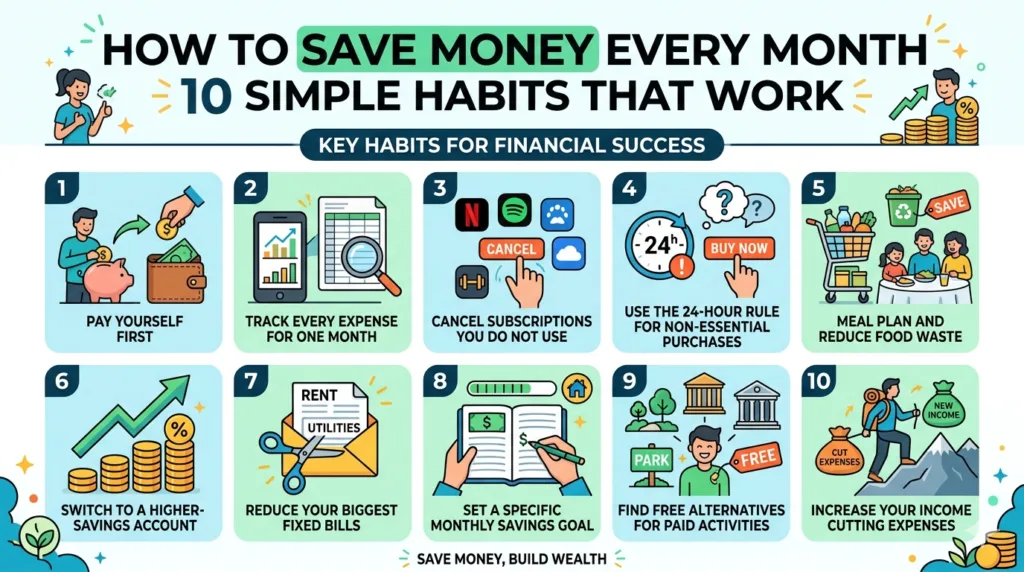
Free tools make this easy. Wave is a completely free invoicing and accounting tool built specifically for freelancers and small businesses. It tracks income, expenses, and invoices in one place and produces basic financial reports at zero cost. Google Sheets works just as well for anyone who prefers a simpler manual system — a straightforward income and expense tracker updated weekly gives you a clear financial picture without any complexity.
According to IRS guidance for self-employed individuals, keeping detailed records of business income and expenses is both a legal requirement and a practical necessity for claiming all legitimate deductions at tax time — reducing your overall tax bill in the process.
Tracking also reveals patterns in how to budget your freelance income that are invisible without data. Which months are consistently strongest? Which expense categories are growing unexpectedly? Which clients pay fastest? This information improves every financial decision you make going forward.
🎯 Tip 6 — Use the 50/30/20 Rule Adjusted for Freelancers
The traditional 50/30/20 budgeting rule — 50 percent of income to needs, 30 percent to wants, 20 percent to savings — is a useful starting framework but needs adjustment for freelancing. Here is how to budget your freelance income using a modified version that accounts for the realities of irregular income and self-employed tax:
- 50% — Essential expenses: Rent, utilities, food, transport, insurance — the non-negotiables
- 25% — Tax savings: Set aside immediately from every payment, untouchable
- 15% — Business and savings: Emergency fund contributions, business tools, equipment, professional development
- 10% — Personal discretionary: Everything else — dining out, entertainment, clothing, travel
These percentages shift once you have a full three-month emergency buffer saved. At that point, the 15 percent previously going to the emergency fund redirects toward investment — index funds, retirement savings, or building additional income streams. The framework is the starting point for how to budget your freelance income at every stage of your freelancing journey.
🔄 Tip 7 — Review and Adjust Every Month
Budgeting is not a one-time setup — it is an ongoing monthly practice that keeps your finances aligned with your actual situation. The final tip for how to budget your freelance income is scheduling a thirty-minute financial review at the end of every single month without exception.
In this review, check five things: total income received versus your baseline target, total expenses versus your budget allocation, tax savings balance, emergency fund progress, and any invoices that are overdue. This monthly check-in catches problems early — an overdue invoice that you notice on day three of the new month is recoverable. One you notice six weeks later may not be.
The monthly review also keeps your budget aligned with your actual life rather than a snapshot from when you first set it up. This is what separates freelancers who achieve real financial stability from those who set up a spreadsheet once and abandoned it. Expenses change. Income grows. Goals evolve. A budget that is reviewed and updated monthly remains a genuinely useful tool for how to budget your freelance income rather than a document you created once and never looked at again.
For more practical tools that support this kind of organised financial management, read our post on the best free tools for freelancers working from home which covers Wave, Google Docs, and several other free resources built specifically for freelancers.
🚀 Start Managing Your Money Like a Pro Today
The difference between freelancers who build real financial stability and those who stay in the feast-or-famine cycle is almost never income level — it is financial habits. Knowing how to budget your freelance income properly is what makes the difference. The tips in this guide on how to budget your freelance income work at $500 per month and at $5,000 per month. The habits matter more than the numbers.
Start with Tip 1 today — calculate your baseline number. That single action gives you a clear financial target and turns your freelancing income from a vague stress into a concrete goal. Everything else builds from there.
For guidance on increasing the income side of the equation alongside managing it better, read our posts on how to make money on Upwork as a beginner and how to start freelancing with no experience.
❓ Frequently Asked Questions
How much should a freelancer save each month?
A good starting target when learning how to budget your freelance income is saving a minimum of 20 percent of your net income each month — split between your tax savings account and your emergency fund. Once your emergency fund reaches three months of expenses, that savings rate redirects toward longer-term investment and wealth building. The exact percentage matters less than the habit of saving consistently every single month without exception.
Should freelancers use a separate bank account for business income?
Yes — separating business and personal accounts is one of the most practical steps in how to budget your freelance income. It makes tax preparation dramatically simpler, gives you a clear picture of business cash flow, and prevents the psychological tendency to spend all available money when income and personal accounts are mixed. Many banks offer free business accounts for sole traders and freelancers.
How do I budget when my freelance income varies wildly every month?
The variable income problem is exactly what the fixed salary approach in Tip 2 solves. Instead of budgeting based on what arrived this month, you pay yourself a consistent fixed amount from your business account regardless of what came in. Surplus months build a buffer in the business account. Slow months draw from that buffer. This smooths out the variability and makes personal budgeting straightforward even when business income is unpredictable — which is the core principle of how to budget your freelance income effectively.
When should a freelancer start thinking about retirement savings?
As early as possible — ideally from your first consistent month of freelance income. Unlike employed workers, freelancers receive no employer pension contributions, making personal retirement savings entirely your own responsibility. Even small monthly contributions to a pension or investment account compound significantly over a decade or more. Building retirement contributions into how to budget your freelance income from the beginning prevents the regret of starting too late.
What business expenses can freelancers deduct from their taxes?
Common deductible freelance business expenses include home office costs, internet and phone bills used for work, software subscriptions, equipment purchases, professional development and courses, and marketing costs. The exact rules vary by country — consult a local accountant or the official tax authority in your region for specifics. Tracking all expenses from day one is essential when learning how to budget your freelance income with tax efficiency in mind.
How do I handle late-paying clients without it disrupting my budget?
The emergency buffer covered in Tip 4 is specifically designed to handle this situation. A three-month buffer means one late payment does not cascade into missed bills or financial stress. On the proactive side, always use written contracts with clear payment terms, send invoices immediately upon project completion, and follow up professionally but firmly on overdue payments. Managing client payment behaviour is an underrated part of how to budget your freelance income successfully.